
Graham’s family arrived in the Kamberg Valley to farm “Danesfort “in 1929. The farm was derelict with only a few perennial streams and no dams. Graham's father, Robert, began farming in earnest after returning from the 2nd World War. Times were tough after the depression but this did not deter Robert and his wife Eliedgh from creating a thriving farming life for themselves and their children Molly, Graham, and John.
Farming was challenging, making diversification of activities essential. The biggest drawback for Robert on Danesfort and their adjoining farms Ballina and Solitude, was the availability of water for irrigation and domestic supply. A secure water source was essential so he embarked on an ongoing programme to build dams for water storage and irrigation of crops and pastures.
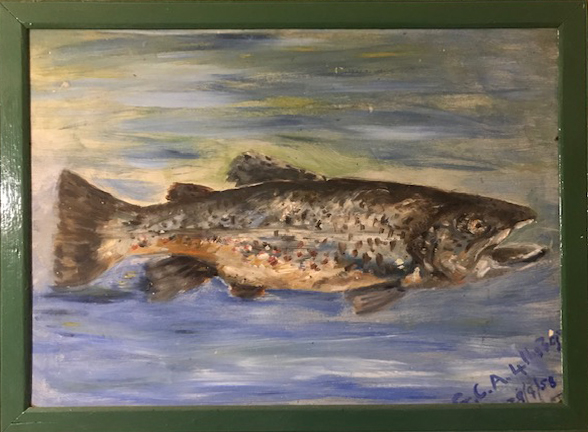
In 1966 Graham joined his father, and in the early 70s, John did the same,to form Danesfort (Pty) Ltd a large farming company. The first dam on Danesfort (now on Sandstone Farm) named “Plover” was built in the early 5O’s using ox-drawn dam scoops. Plover was the first dam in the Kamberg Valley to be stocked with Rainbows and Browns. An artist’s impression of a 4 pound Trout caught by Graham in 1958 on a Bloody Butcher fly bears testimony to this.
After their father passed away in 1982, the brothers continued building dams for water security In the Kamberg valley. By the 1980s, they had built more than twenty sizeable dams on ten farms in the Kamberg Valley.
In 2008, Graham and Sue retired after 40 years of dairy, seed potato, and stock farming. They sold their farms and re-established themselves on a 200-ha portion of the original family farm, Danesfort, now known as Sandstone. They set about creating their dream home and farm which was finally completed in 2011.
The building plan was to look old but conform to modern living standards. As a result, a stable barn, a large homestead and a self-catering cottage were built out of sandstone from an old farm shed. Magnificent old yellow wood beams and flooring, and other materials were sourced from the same shed.
A barn and paddocks were built to home the retired horses.
Elizabeth, their daughter shares an equal passion for horses and is a competitive show jumper.
James their son, a professional polo player who lives in Tennessee USA, wanted to enjoy good trout fishing during their South African holidays. Being a fiercely passionate fly Fisherman, he has fished in many exotic locations. They also realised there was a need for a comfortable, self-accommodating cottage where family and friends could spend time relaxing and sharing.
The family’s love of good South African wines led to the building of a magnificent wine cellar. A unique feature of this, is the age old yellow wood cattle feed mangers sourced from the old shed and converted to store the wine.
The garden has become a beautiful feature of this homestead as Sue created a large traditional English walled garden with raised vegetable beds and an immaculate rose garden. A large indigenous garden features a massive natural rock waterfall created by Graham and his local team. Since the creation of Sandstone ,hundreds of exotic and indigenous trees have been planted creating a beautiful ambience.
Today Sandstone farm, which incorporates Sandstone Cottage and The Garden Loft, is one of the most desirable destinations in the Midlands. Its appeal is further enhanced by its proximity to the Drakensberg mountains, the Midlands Meander and the fact that it’s only a 20-minute drive from Nottingham Road.